Loris Azzaro: Biography, Career and Legacy
Early Life and Education
Loris Azzaro was born on 9 February 1933 in Tunis, then part of French Tunisia, to Italian parents of Sicilian origin. Although he would later become identified with French fashion, his Mediterranean background remained an important element of his creative identity. He moved to France for his studies and attended the University of Toulouse, where he studied literature. Before entering fashion professionally, Azzaro worked as a teacher of Italian in Tunisia.
In 1962, Azzaro settled in Paris. His first activities in fashion were centred not on clothing but on accessories: he created jewellery, evening bags and embellished pieces, initially for his wife, Michelle Carsy, whom he had met in Toulouse in 1957. Michelle subsequently became his muse and an important partner in the development of the Azzaro business.
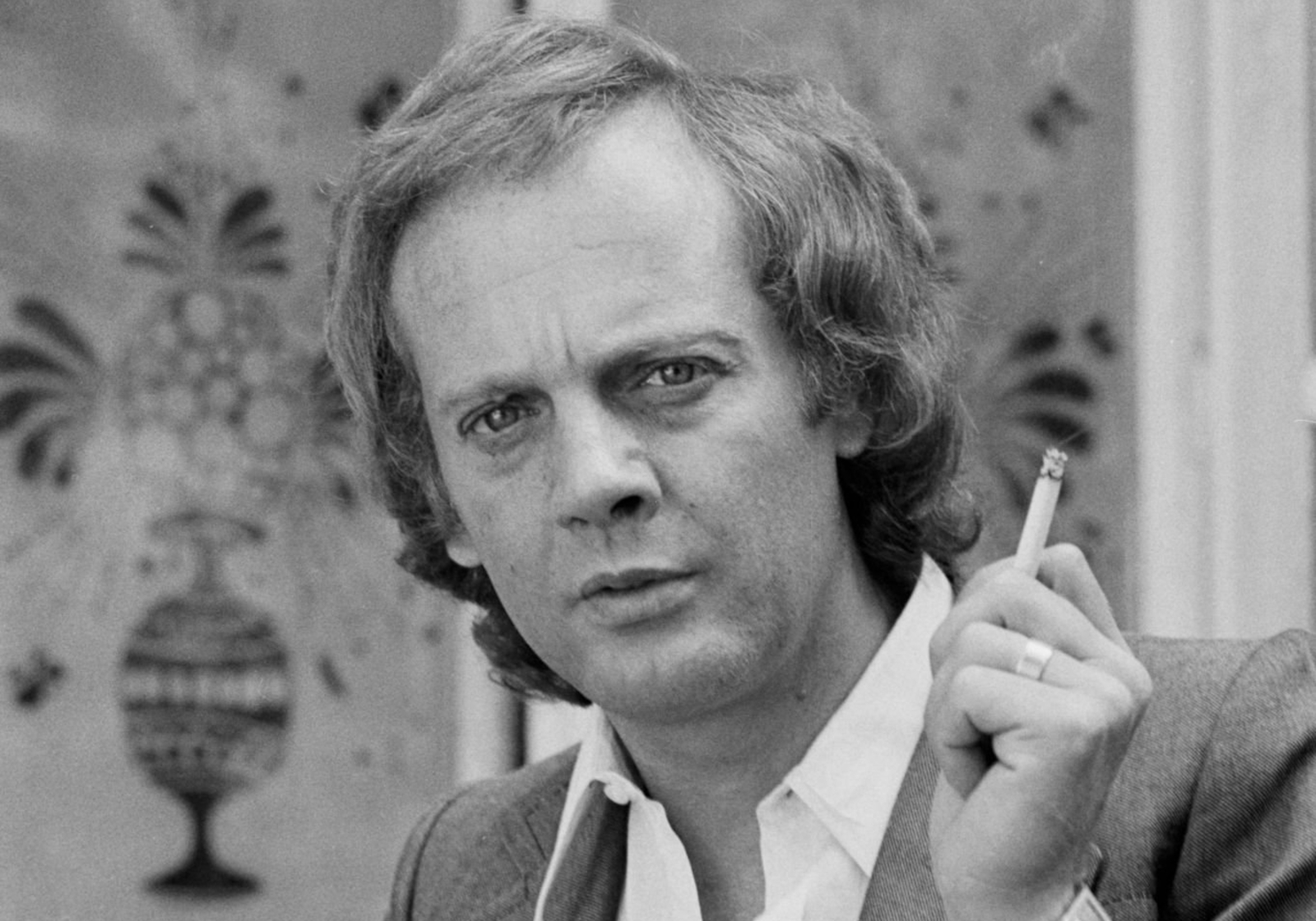
Loris Azzaro in Paris, 1971. Photograph by Giancarlo Botti
Establishment of the Azzaro House
Azzaro began working professionally in fashion in the mid-1960s, establishing his own company and workshop before formally founding the Azzaro fashion house in 1967. That year marked the beginning of his rapid rise in Parisian fashion. He presented his first collection at the Grand Hôtel de Paris and established his house at 65 rue du Faubourg Saint-Honoré.
His early work was distinguished by eveningwear designed to emphasise the body. Draped bustiers, fitted dresses, silk jersey, sequins, transparent materials and metallic embellishment became recurring elements of his vocabulary. Rather than following the restrained elegance associated with conventional Parisian daywear, Azzaro concentrated on glamour, movement and clothes intended for evening and social occasions.
The decisive breakthrough came in 1968 with his celebrated “Anneau” or “Three Rings” dress, constructed around circular elements that framed the décolletage. The design received major international press attention and became one of the defining images of his career. The dress was prominently featured in Elle in December 1968, helping establish Azzaro as one of the most recognisable designers of the period.
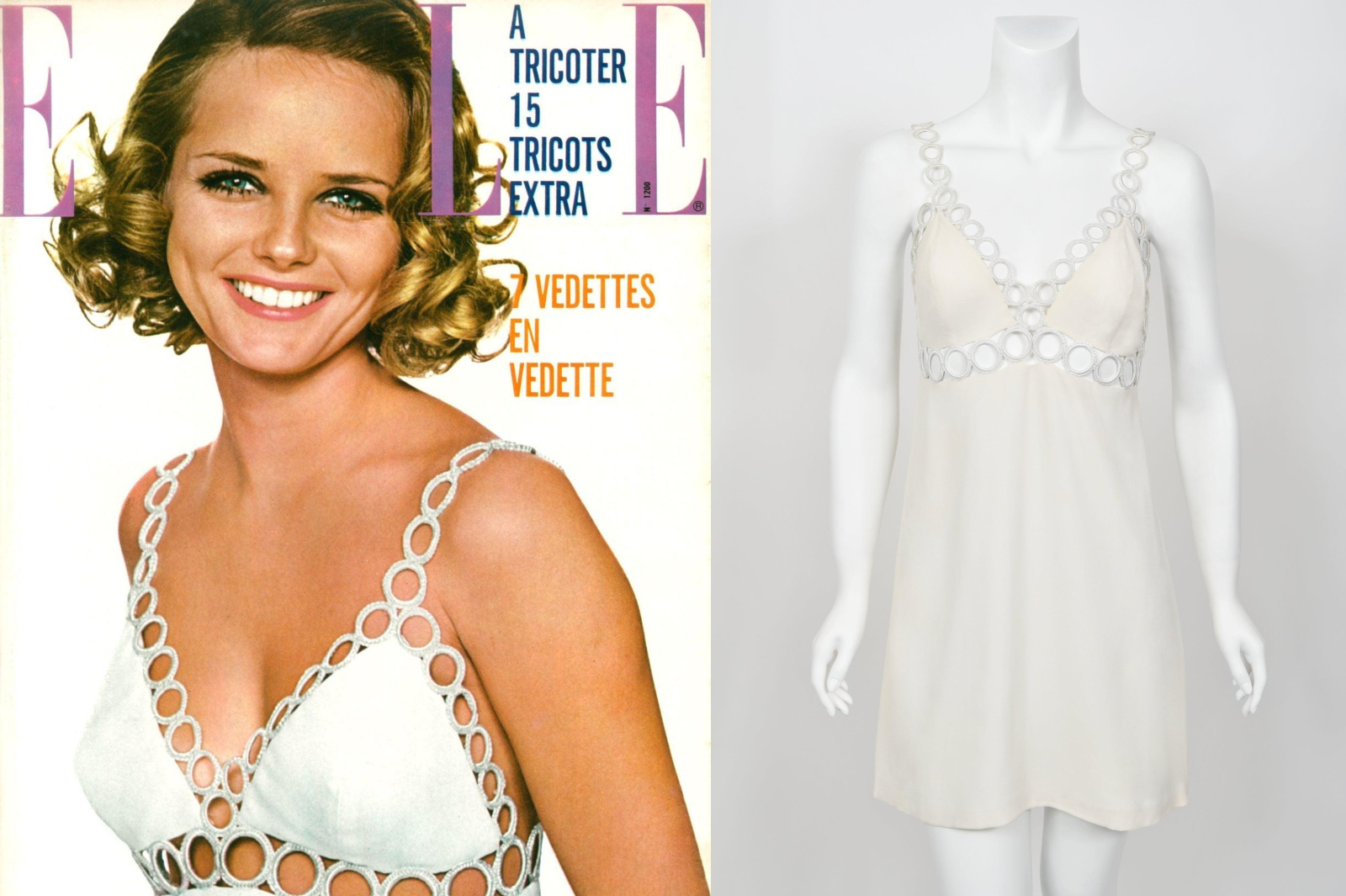
Loris Azzaro's 1968 ring-trimmed dress, an early example of the designer's distinctive approach to sensual eveningwear
Celebrity Clients and the Azzaro Style
By the late 1960s and throughout the 1970s, Azzaro had become closely associated with actresses, singers and members of the international jet set. His clients and wearers included Brigitte Bardot, Jane Birkin, Sophia Loren, Claudia Cardinale, Romy Schneider, Raquel Welch and Marisa Berenson. He also created performance and screen costumes: his designs were worn by Tina Turner, while Liza Minnelli wore Azzaro creations in the 1972 film Cabaret.
The Museo del Traje in Madrid, which preserves a 1972 Azzaro dress in its collection, describes him as one of the highly regarded designers of evening dresses of his period. The museum identifies silk jersey, draping, Lurex mesh and chains among the characteristic materials and techniques associated with his work.
Azzaro's aesthetic was built around sensuality rather than architectural construction. Long, fluid silhouettes, empire lines, body-conscious sheaths, plunging necklines, draped bustiers and transparent or embellished surfaces allowed his clothes to move with the wearer. His designs became particularly suited to the glamour of 1970s nightlife and the red-carpet culture that developed around international celebrities.
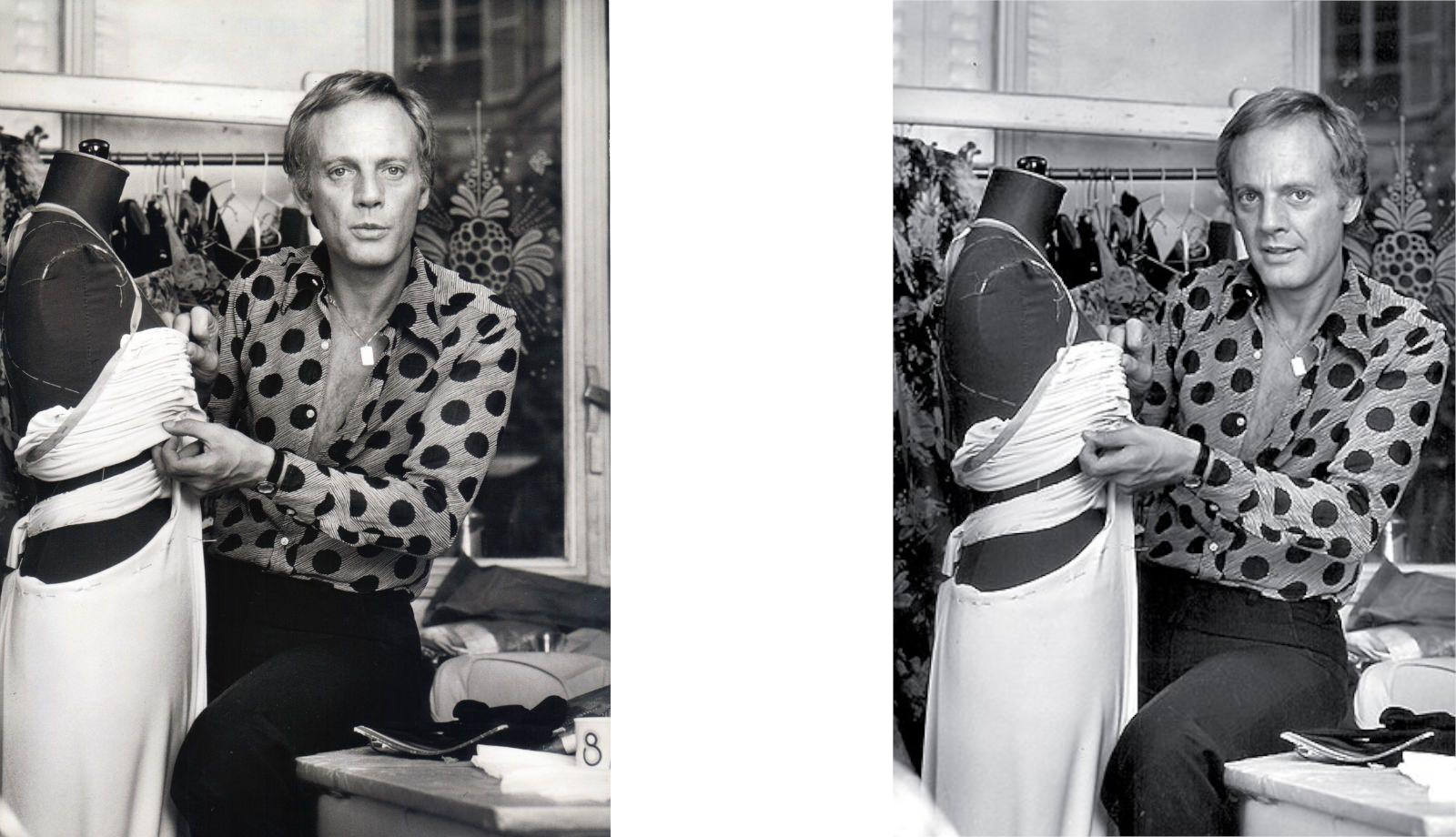
Loris Azzaro in his Paris studio at 65 Faubourg Saint-Honoré, April 1974
Azzaro himself famously defined his ideal dress as one “that makes a woman want to put it on and a man want to take it off.” The quotation, frequently associated with his philosophy of design, encapsulates the overtly sensual character of his work.
Expansion into Accessories and Perfumery
During the 1970s, the Azzaro business expanded beyond fashion into accessories and fragrance. The house introduced its first perfume, Azzaro Couture, in 1975. The fragrance was created as a feminine counterpart to the designer's fashion universe, and its presentation reflected Azzaro's interest in decorative objects as well as clothing.
Azzaro subsequently entered the men's fragrance market. In 1978, the house launched Azzaro Pour Homme, which became one of its most commercially significant fragrances and an important part of the brand's long-term identity. The expansion into perfumery established a second major dimension of Azzaro's legacy: after his death, the name continued to be associated with fragrance as well as fashion.
The designer's approach to fashion and perfume was closely connected. Contemporary accounts noted that he regarded fragrance as an essential complement to women's clothing, rather than as a separate category.
Later Career
Azzaro continued to develop his fashion business through the 1980s and early 1990s, while the house expanded through ready-to-wear and licensing. He also worked outside conventional fashion: in 1984, he designed costumes for Marc Camoletti's theatre production Le Bluffeur.
In 1988, Azzaro was appointed a Chevalier of the Légion d'honneur, one of France's highest national distinctions. In 1992, the house expanded further into men's fashion, introducing a licensed menswear line and additional ready-to-wear activity.
Although the Azzaro name became increasingly diversified commercially, Loris Azzaro remained principally identified with eveningwear and the glamorous image he had established during the 1960s and 1970s.
Death and Legacy
Loris Azzaro died in Paris on 20 November 2003, aged 70. His death was reported by Le Monde and other major publications as the end of a career that had connected Parisian fashion with the international world of cinema, music and celebrity.
British Vogue described Azzaro as a designer whose glamorous creations helped define the public image of stars such as Sophia Loren and Raquel Welch. His daughter Beatrice Azzaro remembered him as “a creative genius” and as someone passionate about “all expressions of beauty and particularly those of women.”
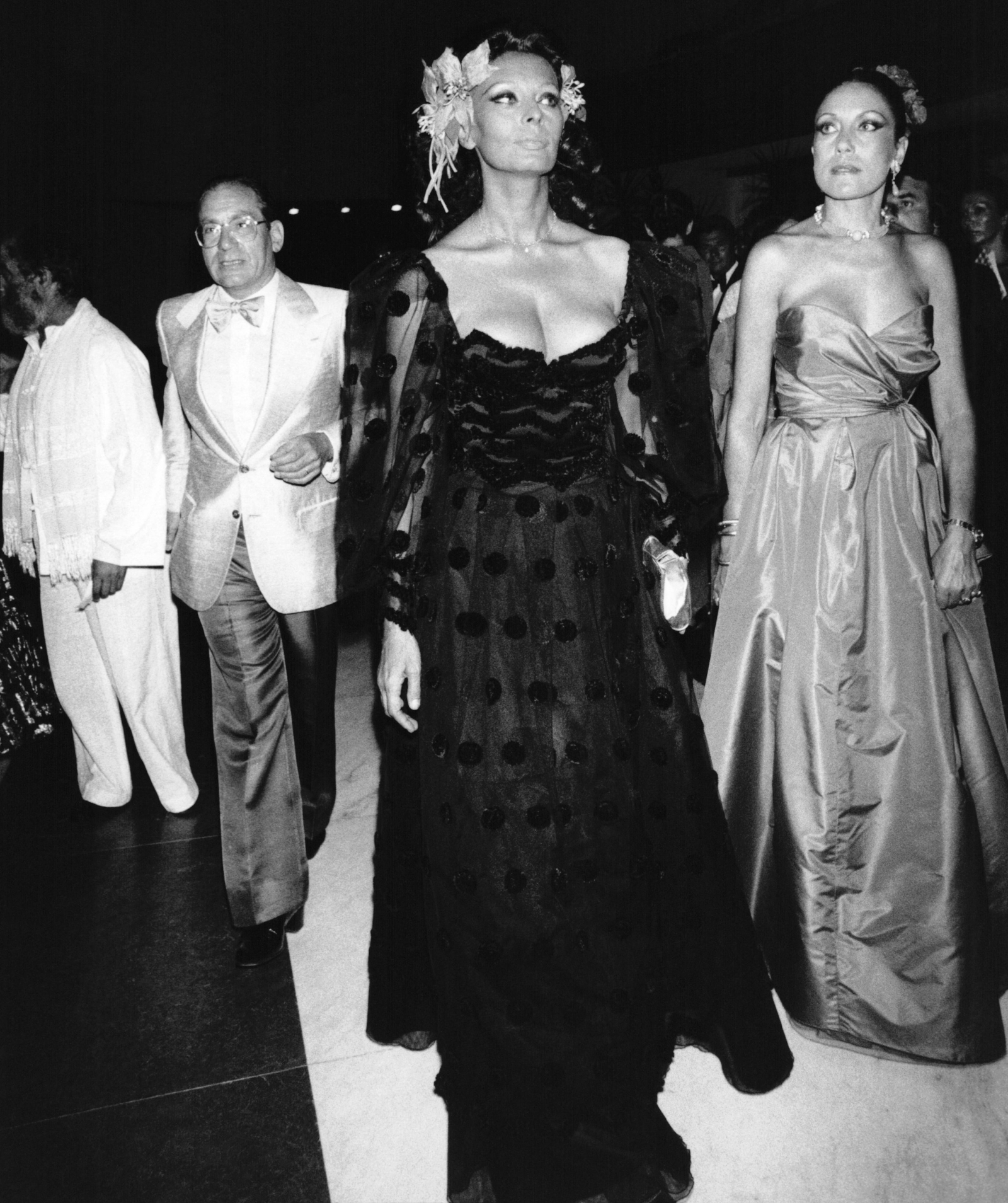
Sophia Loren wearing a Loris Azzaro gown at the Red Cross Gala in Monaco, 1979
Azzaro's importance lies in the distinctive position he established between haute-fashion glamour, celebrity dressing and commercial fragrance. His designs helped make sensual eveningwear a defining part of the visual language of the 1970s, while his use of jersey, draping, metallic materials and body-conscious construction became recurring references in the history of modern fashion.
The house he founded in 1967 continued after his death under successive creative directors. His name also survived through the Azzaro fragrance business, ensuring that his legacy extended beyond the clothes he personally designed. In 2006, an organisation inspired by his stated interest in environmental and humanitarian causes, the Institut Loris Azzaro, was established in Toulouse.